Understanding the AI Harness
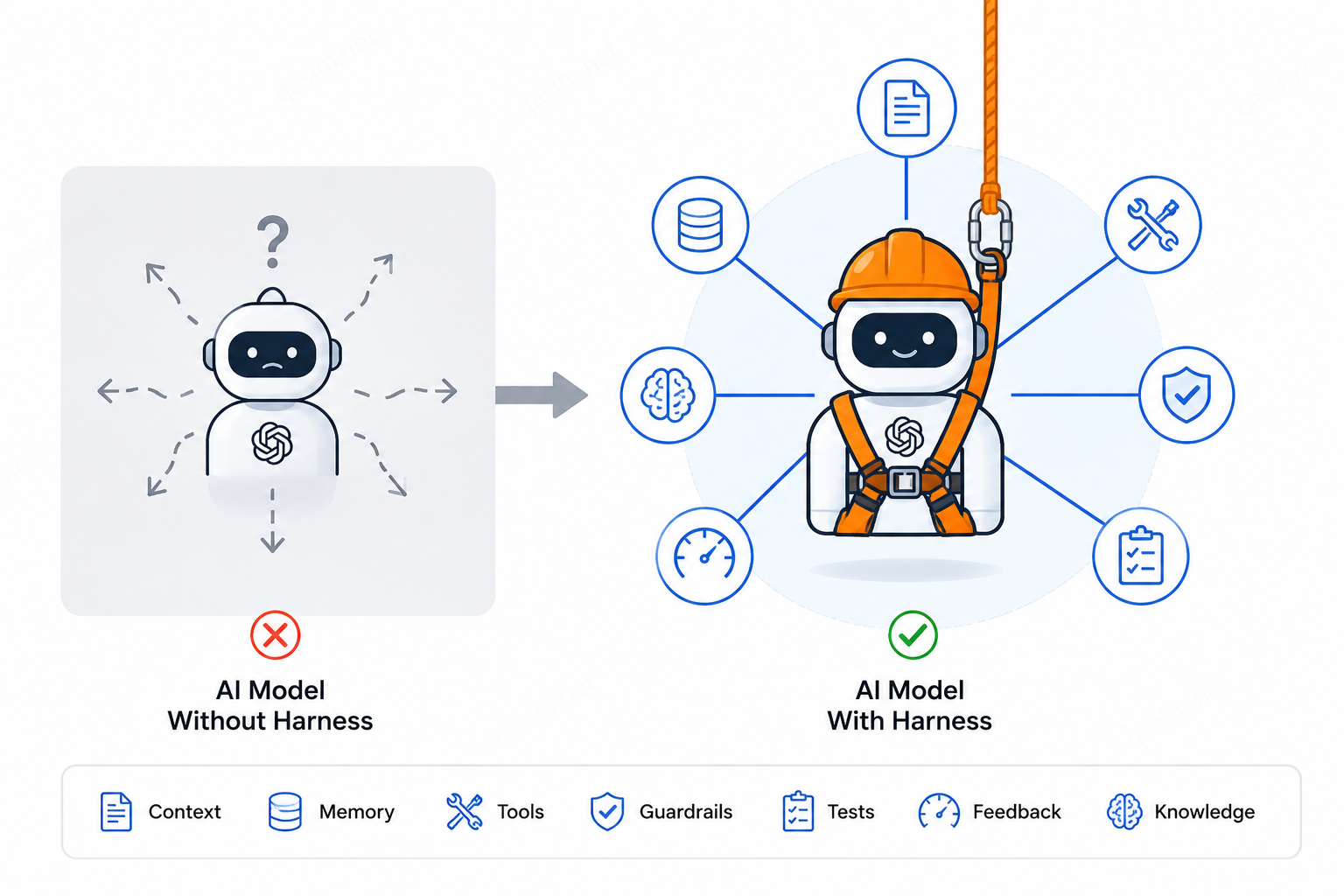
When people talk about Artificial Intelligence, they often focus on the AI model.
Questions like:
- Is it ChatGPT?
- Is it Gemini?
- Is it Claude?
- Which model is the smartest?
While these are important questions, they often overlook something even more important.
An AI model alone cannot build reliable software, answer complex business questions, or automate an organization.
Just like a highly skilled employee needs training, tools, and guidance, an AI model also needs a complete support system.
That support system is called the AI Harness.
Imagine Hiring a New Employee
Imagine your company hires an experienced software engineer.
On their first day, they are highly intelligent.
But they don’t know:
- What your company does
- Your products
- Your customers
- Your coding standards
- Your business rules
- Your software architecture
- Your internal tools
- Your security policies
Would you simply hand them a laptop and say:
“Go build our next application.”
Probably not.
Instead, you would provide everything they need to succeed.
You would give them:
- Company documentation
- Coding guidelines
- Access to internal systems
- Development tools
- Architecture diagrams
- Project requirements
- Mentors
- Regular feedback
- Code reviews
After a few weeks, that same engineer becomes productive because they understand how your organization works.
The engineer didn’t become smarter.
They simply received the right environment.
AI works exactly the same way.
Intelligence Isn’t Enough
An AI model is incredibly knowledgeable. It has learned from enormous amounts of public information. But it doesn’t automatically know anything about your business.
It doesn’t know:
- Your project
- Your database
- Your customers
- Your APIs
- Your coding standards
- Your preferred architecture
- Your workflows
Without this information, the AI is simply making educated guesses. The better the information you provide, the better its decisions become.
This Support System Is the AI Harness
The AI Harness is everything that surrounds an AI model and enables it to perform useful work. Think of it as the AI’s working environment. Instead of relying only on its general knowledge, the AI can now work using your organization’s knowledge, processes, and tools.
What Does an AI Harness Contain?
1. Context
Context tells the AI where it is working.
It may include:
- Project requirements
- Business objectives
- Architecture documents
- Coding standards
- Company terminology
Without context, AI gives generic answers. With context, AI gives relevant answers.
2. Memory
Humans remember previous conversations.
AI agents also need memory.
Memory allows the AI to remember:
- Previous tasks
- Project decisions
- User preferences
- Earlier conversations
- Long-term project goals
Without memory, every conversation starts from zero.
3. Tools
Sometimes AI needs more than knowledge.
It needs action.
Instead of answering from memory, it can:
- Search a database
- Read a document
- Send an email
- Query an API
- Create a calendar event
- Execute a script
These capabilities come from tools.
4. Agent Skills
Just like employees have different job roles, AI agents can have specialized skills.
For example:
A Sales Agent can:
- Generate quotations
- Create proposals
- Recommend products
A Support Agent can:
- Answer customer questions
- Open support tickets
- Check order status
An Accounting Agent can:
- Create invoices
- Verify payments
- Generate reports
Each skill makes the AI more focused and more reliable.
5. Guardrails
Every organization has rules.
Employees cannot access every document.
They cannot approve every payment.
They cannot change every system.
AI also needs boundaries.
Guardrails define:
- What AI is allowed to do
- What AI cannot do
- Security policies
- Compliance requirements
- Approval workflows
Guardrails help ensure AI behaves safely and consistently.
6. Evaluations
How do you know an employee has completed a task correctly?
You review the work.
AI needs the same process.
Evaluations verify:
- Was the answer correct?
- Was the code accurate?
- Did the tests pass?
- Were company standards followed?
Without evaluation, mistakes can go unnoticed.
Why Is It Called a Harness?
The word harness comes from the idea of directing power.
Think about a safety harness used by someone working at height.
The harness doesn’t make the worker stronger.
It makes the worker safer.
It provides stability.
It reduces risk.
It allows the worker to perform difficult tasks with confidence.
An AI Harness serves a similar purpose.
It doesn’t make the AI model more intelligent.
It helps that intelligence work safely, consistently, and effectively in real-world situations.
The Difference Between an AI Model and an AI Agent
Many people use these terms interchangeably.
They’re not the same.
An AI Model is simply the intelligence.
An AI Agent is the intelligence plus the harness.
AI Model
        +
Context
        +
Memory
        +
Tools
        +
Skills
        +
Guardrails
        +
Evaluations
        =
Reliable AI Agent
The harness transforms a powerful model into a dependable assistant capable of performing meaningful work.
Why Businesses Should Care
As AI becomes part of everyday business operations, success will depend on much more than selecting the latest model.
Organizations that build strong AI Harnesses will benefit from:
- Better accuracy
- More consistent results
- Improved security
- Lower operational costs
- Faster software development
- Better decision-making
- Easier maintenance
- Greater scalability
The competitive advantage won’t come from owning a smarter AI model.
It will come from building a smarter environment around that model.
The Future of AI
As AI models continue to improve, they will become increasingly similar in capability.
What will truly differentiate successful AI systems is everything built around them.
The future belongs to organizations that understand how to combine context, memory, tools, skills, guardrails, and evaluations into a reliable AI Harness.
Just as a talented employee performs best with the right training and support, an AI model delivers its greatest value when it operates within a well-designed harness.
The model provides the intelligence.
The harness transforms that intelligence into dependable results.