Understanding Agent Skills

Why the Future of AI Looks More Like a Team Than a Superhero
When most people imagine AI, they picture a single super-intelligent assistant capable of doing everything.
- Ask it to write code.
- Analyze data.
- Generate reports.
- Manage inventory.
- Reply to customers.
One AI. Unlimited abilities.
While this sounds impressive, real-world experience is teaching us a different lesson. The future of AI is not one giant agent that knows everything. The future is a team of specialized agents, each with its own skills.
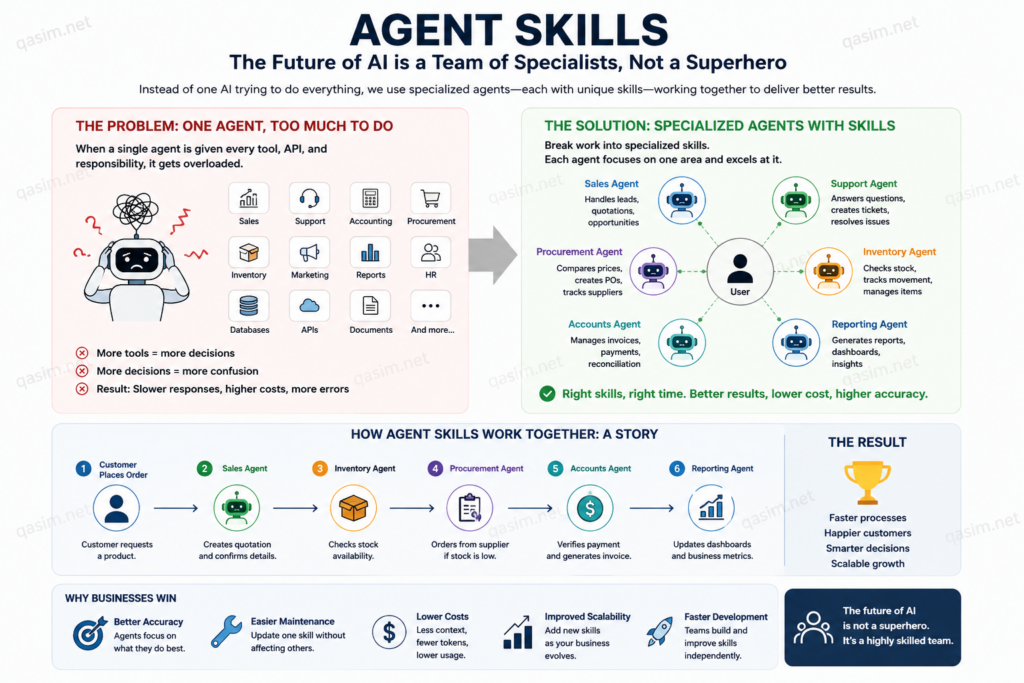
The Story of the New Employee
Imagine you own a growing business.
On Monday, you hire a new employee and tell them:
“Your job is to handle sales, customer service, accounting, procurement, inventory, marketing, HR, technical support, and reporting.”
Most people would agree this is unrealistic. Even the smartest employee would struggle. There are simply too many responsibilities, too many decisions, and too much information to process.
Now imagine a different approach.
You hire:
- A Sales Executive
- An Accountant
- A Procurement Officer
- A Customer Support Representative
- An Inventory Controller
Each person becomes highly skilled in their specific area. When they need help, they collaborate. The business runs more efficiently because everyone focuses on what they do best. This is exactly how modern AI systems are evolving.
What Is an Agent Skill?
An Agent Skill is a specialized capability that enables an AI agent to perform a specific task effectively. Think of it as a profession or job role for an AI agent.
Examples include:
Customer Support Skill
Can:
- Answer customer questions
- Create support tickets
- Check order status
- Escalate issues
Sales Skill
Can:
- Generate quotations
- Follow up on leads
- Recommend products
- Track opportunities
Procurement Skill
Can:
- Compare supplier prices
- Generate purchase orders
- Track deliveries
- Monitor stock levels
Reporting Skill
Can:
- Generate dashboards
- Analyze trends
- Create summaries
- Produce management reports
Instead of teaching one AI everything, we create specialists.
Why Bigger Isn’t Always Better
Many organizations make the mistake of continuously adding more tools and responsibilities to a single AI agent.
Eventually the agent becomes overloaded.
It has access to:
- Hundreds of APIs
- Multiple databases
- Thousands of documents
- Countless instructions
At first this seems powerful.
In reality it often creates:
- Slower responses
- Higher costs
- More confusion
- Increased errors
This is known as Context Saturation and Tool Bloat.
The agent spends more time deciding what to use than actually solving the problem.
A Restaurant Analogy
Imagine a restaurant where every employee does everything.
The chef takes orders.
The waiter cooks food.
The cashier cleans tables.
The cleaner manages inventory.
Chaos would quickly follow.
Successful restaurants operate differently.
Each person has a role.
Each role has specific responsibilities.
Together they create a smooth customer experience.
AI agents work the same way.
How Agent Skills Work Together
Consider a customer placing an order. Instead of one giant AI handling everything, a group of specialized agents collaborate.
Customer Agent
- Receives the request.
Sales Agent
- Creates the quotation.
Inventory Agent
- Checks stock availability.
Procurement Agent
- Determines whether additional stock is required.
Finance Agent
- Verifies payment status.
Reporting Agent
- Updates dashboards and metrics.
Each agent performs a specific task and passes information to the next specialist. The result is faster, more accurate, and easier to maintain.
Agent Skills in CRMLogiq
Imagine CRMLogiq evolving into an AI-powered platform. Instead of one large assistant, it could contain:
Customer Management Agent
- Maintains customer information.
Quotation Agent
- Creates and manages quotations.
Sales Order Agent
- Processes customer orders.
Procurement Agent
- Optimizes purchasing decisions.
Inventory Agent
- Tracks stock movement.
Accounts Agent
- Handles invoices and payments.
Reporting Agent
- Generates management insights.
Each skill becomes a reusable building block.
New functionality can be added without affecting existing agents.
Why Businesses Should Care
The value of Agent Skills extends beyond technology.
They provide:
Better Accuracy
Agents focus only on relevant tasks.
Easier Maintenance
Changes affect one skill rather than the entire system.
Lower Costs
Less unnecessary context means fewer tokens and API calls.
Improved Scalability
New skills can be added as business requirements grow.
Faster Development
Teams can build and improve individual skills independently.
The Future of AI
For years, software evolved from large monolithic applications to smaller microservices.
AI is following a similar path.
We are moving from: One Giant Agent to Many Specialized Agents working together.
The most successful AI systems of the future will not be the ones with the largest prompts or the most tools. They will be the ones with the right skills, the right responsibilities, and the ability to collaborate effectively.
Just as successful businesses rely on specialized teams, successful AI systems will rely on specialized agent skills.
The future of AI is not a superhero. It’s a highly skilled team.