The Real Future of AI Development
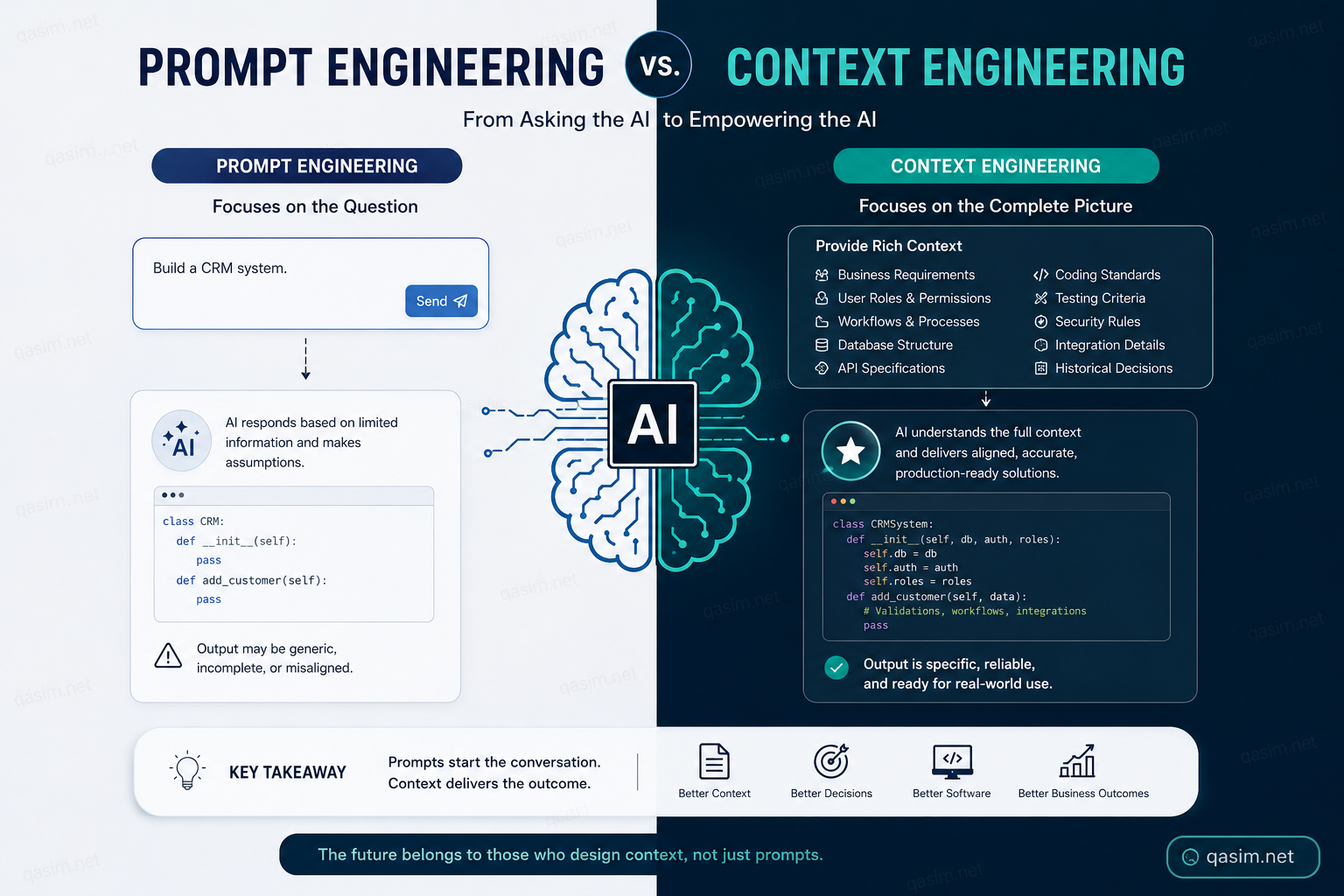
Prompt Engineering vs Context Engineering: The Real Future of AI Development
Artificial Intelligence has transformed the way software is built. Over the past few years, “Prompt Engineering” became one of the most discussed skills in the AI industry. Developers and businesses focused on learning how to write better prompts to obtain better responses from AI systems.
However, as AI evolves from simple chat assistants into autonomous agents capable of planning, coding, testing, and executing complex tasks, a new discipline is emerging: Context Engineering.
What is Prompt Engineering?
Prompt Engineering is the practice of crafting instructions that guide an AI model toward a desired response.
Examples include:
- Write a Python function to calculate GST.
- Create a sales proposal template.
- Design a restaurant booking application.
The quality of the output often depends on how clearly the request is written.
Prompt engineering works well for simple tasks, brainstorming, content generation, and small coding requirements.
The Limitations of Prompt Engineering
Prompt engineering assumes that the AI has sufficient understanding of the problem.
In real-world business applications, this assumption is rarely true.
Consider the instruction:
“Build a CRM system.”
Questions immediately arise:
- What type of CRM?
- What industries will use it?
- What are the user roles?
- What workflows are required?
- What integrations are needed?
- What security standards must be followed?
Without this information, AI can only make assumptions.
What is Context Engineering?
Context Engineering is the practice of providing AI systems with the complete environment required to make intelligent decisions.
Instead of focusing only on prompts, context engineering focuses on supplying:
- Business requirements
- Architecture documents
- Workflow diagrams
- Database structures
- Coding standards
- API specifications
- Historical decisions
- User permissions
- Testing criteria
- Security policies
The goal is to ensure that AI operates with the same knowledge a skilled team member would have before beginning work.
Why Context Matters More Than Prompts
Imagine hiring a new employee.
You would not simply say:
“Build our business software.”
You would provide documentation, processes, policies, examples, objectives, and expected outcomes.
AI agents require the same level of information.
The better the context, the better the decisions.
The Shift from Coding to System Design
Traditionally, developers spent most of their time writing code.
With modern AI coding agents, implementation is becoming increasingly automated.
The human role is shifting toward:
- Defining requirements
- Designing workflows
- Creating architecture
- Establishing guardrails
- Verifying outputs
Success is no longer determined by how fast code is written, but by how clearly intent and constraints are defined.
Real-World Example
Prompt Engineering Approach:
“Build a restaurant management system.”
Context Engineering Approach:
Provide:
- Functional requirements
- Menu management workflow
- Table reservation process
- Order lifecycle
- User roles and permissions
- Inventory management rules
- Payment integration requirements
- Reporting requirements
- UI standards
- Testing criteria
The difference in outcome is dramatic.
One generates software.
The other generates business-ready software.
The Future of AI Development
As AI agents become more autonomous, prompt engineering will remain useful, but context engineering will become the defining skill for developers, architects, business analysts, and technology leaders.
The future belongs to professionals who can transform business knowledge into structured context that AI systems can understand and execute.
Prompts tell AI what to do.
Context tells AI how to think about the problem.
That difference will define the next generation of software development.