Rubik’s Cube Life Map: 6 Sides, Centers, Edges, Corners (Real-Life Values)
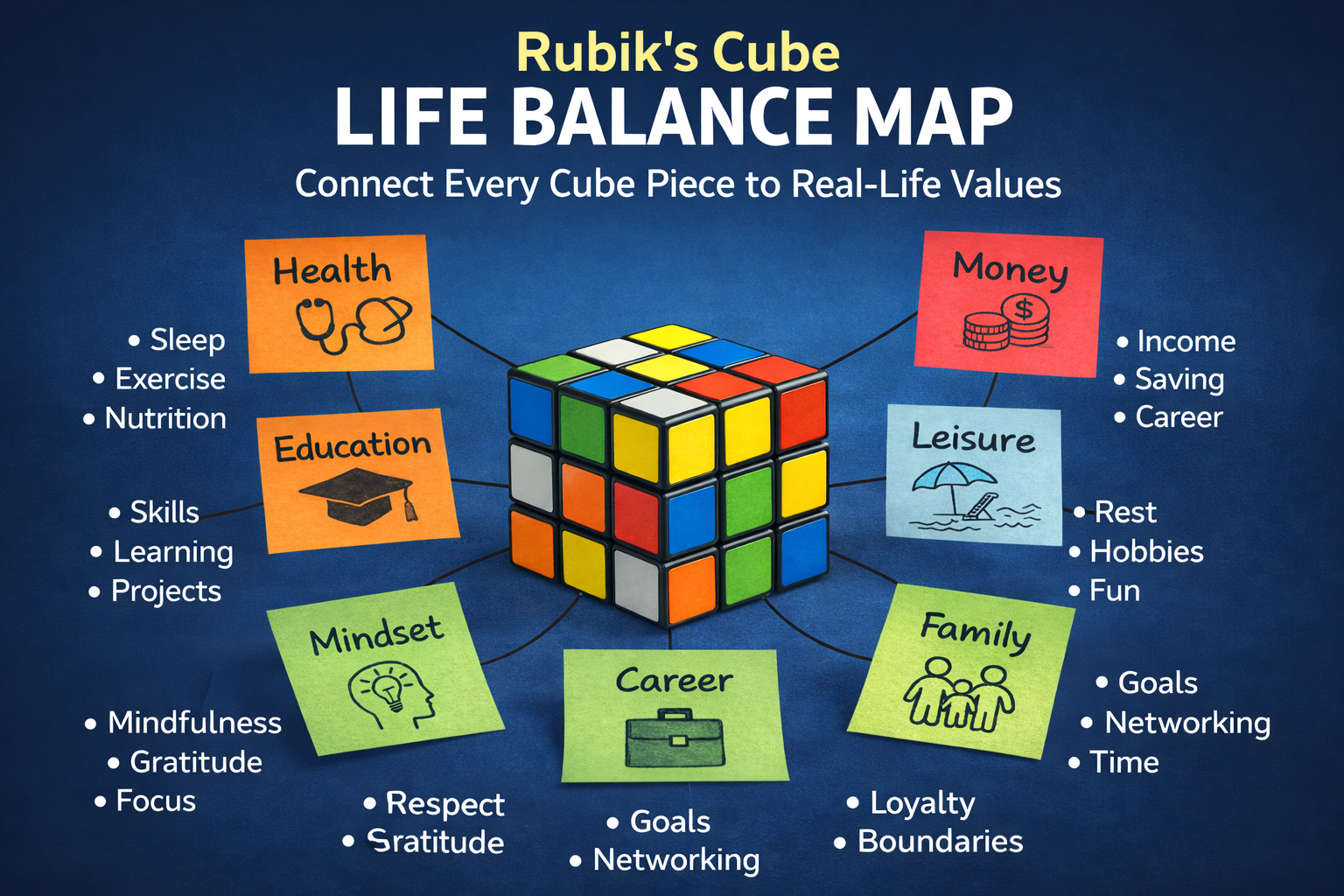
If a Rubik’s Cube can be solved by understanding each piece, life can also be improved by understanding each area.
In this post, we map the cube into a simple life framework: center, sides, edges, and corners.
Related post: Rubik’s Cube of Life: How to Solve Real Problems Like a Cube
A Rubik’s Cube has:
- Center pieces (core identity)
- 6 sides (major life areas)
- Edge pieces (connections between two areas)
- Corner pieces (heavy responsibilities connecting three areas)
One-line link to the main idea:
Let’s connect every cube piece to real-life values, so solving the cube becomes a simple method to balance and improve our life.
Center Piece: Core Identity (Values That Control Everything)
The cube centers decide what each side becomes. In life, your center is your character and values.
Core Identity (9 values)
- Discipline
- Honesty
- Purpose
- Consistency
- Responsibility
- Self-control
- Patience
- Growth mindset
- Gratitude
Also read: Complete vs Perfect: The Balance Concept
Side 1: Health (9 points)
Health is the base of energy, mood, focus, and confidence.
Health checklist
- Sleep routine
- Nutrition
- Hydration
- Exercise
- Hygiene
- Stress control
- Medical checkups
- Fitness discipline
- Recovery and rest
Side 2: Education and Skills (9 points)
Skills turn effort into results. This side is your learning power.
Education and skills checklist
- Daily learning
- Practice time
- Reading habit
- Writing and notes
- Projects
- Problem solving
- Communication
- Digital skills
- Certifications
Side 3: Money and Career (9 points)
Career gives direction. Money gives stability.
Money and career checklist
- Career goals
- Skills for job
- Income streams
- Budgeting
- Saving
- Investing basics
- Time management
- Networking
- Professional growth
Side 4: Family (9 points)
Family is support, roots, and responsibility.
Family checklist
- Respect
- Time together
- Support
- Listening
- Responsibility
- Conflict handling
- Helping at home
- Trust
- Traditions and bonding
Side 5: Friends and Social Life (9 points)
Social life can build you or break you. Choose the right circle.
Friends checklist
- Good company
- Boundaries
- Communication
- Loyalty
- Avoid toxic people
- Social confidence
- Teamwork
- Fun time balance
- Social support
Side 6: Mindset and Inner Peace (9 points)
Mindset decides whether life feels easy or difficult.
Mindset checklist
- Positive thinking
- Emotional control
- Self-awareness
- Confidence
- Focus
- Avoid overthinking
- Gratitude practice
- Mental rest
- Self-belief
Edge Pieces: Life Connections (2-side bridges)
Edge pieces connect two sides. In life, these are the “bridge skills” that keep balance.
Health + Mindset
- Stress management
- Self-control
- Meditation / breathing
Education + Career
- Practical projects
- Internship / experience
- Skill upgrades
Money + Family
- Financial planning
- Family needs balance
- Responsible spending
Friends + Mindset
- Emotional support
- Peer influence control
- Confidence building
Health + Career
- Energy management
- Routine discipline
- Work-life balance
Education + Friends
- Study circle
- Healthy competition
- Positive influence
Related post: How Relationships Affect Life Balance
Corner Pieces: High-Pressure Responsibilities (3-side challenges)
Corner pieces touch three faces, so they are hardest. In life, corners are heavy responsibilities that demand maturity.
Student Corner (Education + Mindset + Friends)
- Focus + discipline + avoiding distractions
Career Builder Corner (Career + Money + Mindset)
- ambition + pressure handling + growth
Family Leader Corner (Family + Money + Mindset)
- responsibility + stability + patience
Balanced Life Corner (Health + Family + Career)
- time split + energy control + priorities
Final Thought
A solved cube is not random. It is organized.
A stable life is the same.
When the center is strong, the sides are balanced, and the edges and corners are aligned, life becomes clear and controlled.
Go back to main post: Rubik’s Cube of Life: How to Solve Real Problems Like a Cube