Open Responses API
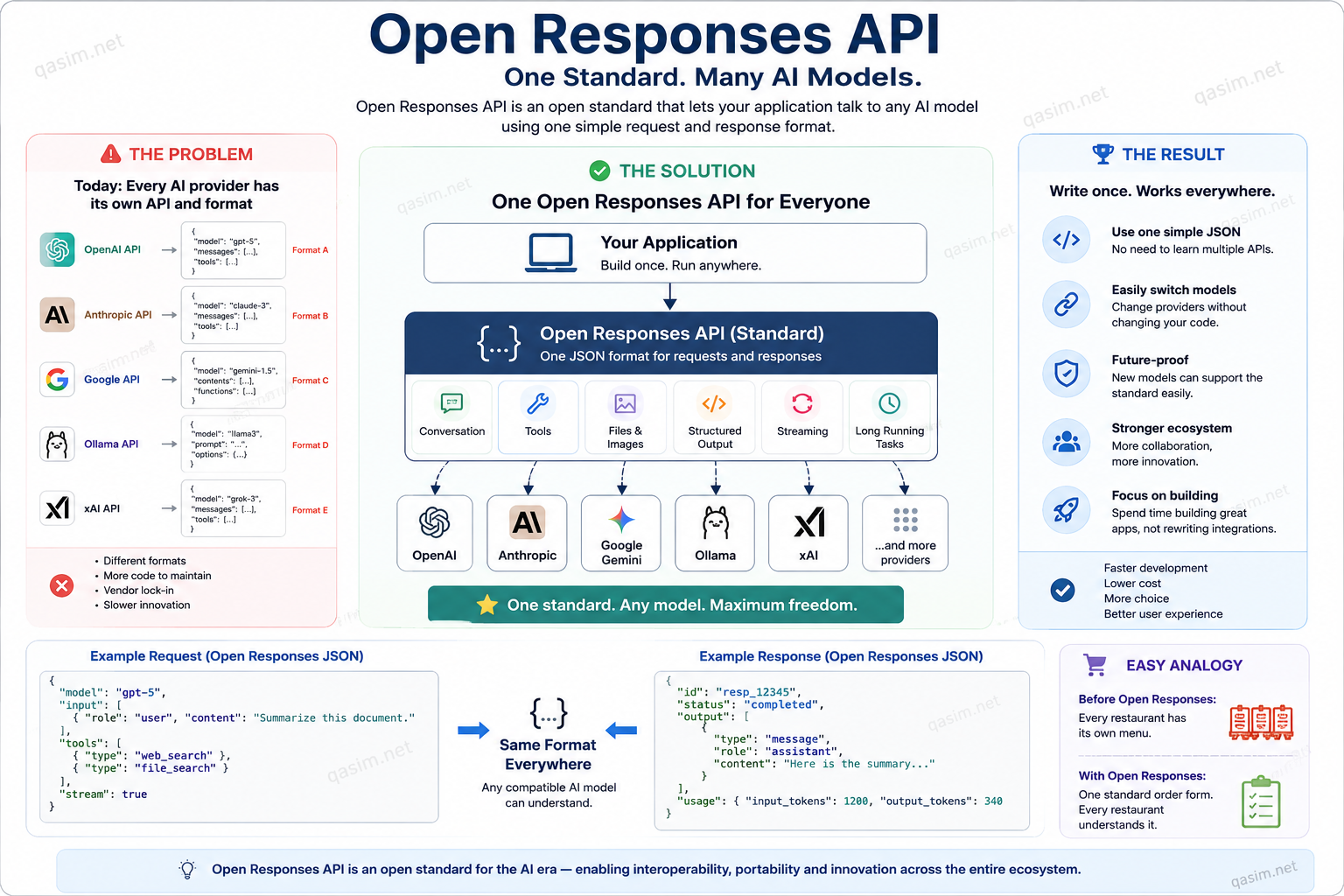
The Open Standard That Could Transform AI Application Development
Build Once. Connect to Many AI Models.
Introduction
Artificial Intelligence is evolving at an incredible pace. Today, developers can choose from a growing number of Large Language Models (LLMs), including those from OpenAI, Anthropic, Google, Meta, Mistral, xAI, Cohere, and many others. Each model offers unique strengths, pricing, and capabilities.
While this diversity is great for innovation, it creates a significant challenge for developers: every AI provider exposes its own API.
If an application needs to support multiple AI providers, developers often have to learn different request formats, response structures, authentication methods, tool-calling mechanisms, and streaming implementations. As the AI ecosystem grows, maintaining these integrations becomes increasingly difficult.
This is exactly the problem that Open Responses API aims to solve.
What is Open Responses?
Open Responses is an open standard for communicating with AI models.
Instead of every AI provider defining its own API, Open Responses provides a common request and response specification that can be implemented by any AI platform.
Think of it as a universal language between AI applications and AI models.
Rather than writing different code for every provider, developers write their application once using the Open Responses standard.
Application
      │
      ▼
Open Responses API
      │
 ┌────┼────┐
 ▼    ▼    ▼
OpenAI Anthropic Google
The application communicates using one standard format, while the underlying AI provider handles the model-specific implementation.
The Problem Today
Imagine building an AI-powered customer support system.
Initially, you decide to use OpenAI.
Six months later:
- Anthropic releases a better reasoning model.
- Google launches a cheaper model.
- Your customer wants to use an on-premise model like Ollama.
- Another customer requires a private deployment using vLLM.
Suddenly your application needs to support multiple providers.
Unfortunately, every provider has its own API.
Application

├── OpenAI API
├── Anthropic API
├── Google API
├── Ollama API
├── xAI API
└── Mistral API
Each integration requires different code.
Each provider introduces new features differently.
Each update increases maintenance.
This leads to:
- Duplicate development effort
- Higher maintenance costs
- Vendor lock-in
- Slower feature development
- Increased testing complexity
A Real-World Analogy
Imagine every mobile phone manufacturer invented its own charging connector.
Your home would look like this:
- Samsung Charger
- Apple Charger
- Sony Charger
- Nokia Charger
- Motorola Charger
Every device requires a different cable.
Now imagine USB-C.
One cable works everywhere.
Open Responses aims to do exactly this for AI APIs.
Instead of learning multiple API formats, developers learn one.
Why Was Open Responses Created?
The AI industry is rapidly expanding, but without common standards, interoperability becomes increasingly difficult.
The creators of Open Responses recognized that many AI providers already support similar concepts:
- Conversations
- Messages
- Tool calling
- Function execution
- Structured outputs
- Images
- Audio
- Streaming
- Long-running tasks
Although these capabilities are similar, every provider represents them differently.
Open Responses proposes a shared specification so applications can communicate consistently across providers while still allowing each provider to innovate internally.
Understanding the Architecture
The architecture is intentionally simple.
                Your Application
                      │
                      ▼
          Open Responses Standard
                      │
      ┌───────────────┼───────────────┐
      ▼               ▼               ▼
   OpenAI        Anthropic      Google
      ▼               ▼               ▼
    GPT           Claude         Gemini
Your application only understands one language.
Every AI provider translates that request into its own model.
Understanding the Request
Instead of different JSON formats, Open Responses defines a common structure.
Example:
{
  "model": "gpt-5",
  "input": [
    {
      "role": "user",
      "content": "Summarize this document."
    }
  ],
  "tools": [
    {
      "type": "web_search"
    },
    {
      "type": "file_search"
    }
  ]
}
This request simply describes:
- Which model to use
- The user’s input
- The tools available
- Any additional execution options
The application doesn’t need to worry about provider-specific implementations.
Understanding the Response
Likewise, responses follow a common structure.
{
  "id": "resp_12345",
  "status": "completed",
  "output": [
    {
      "type": "message",
      "role": "assistant",
      "content": "Here is the summary..."
    }
  ]
}
Applications can process responses consistently without custom parsing for every provider.
Benefits of Open Responses
1. Build Once
Developers write one integration instead of many.
2. Reduce Vendor Lock-in
Applications can switch AI providers with minimal code changes.
3. Lower Maintenance
A single API implementation means fewer bugs and easier updates.
4. Faster Innovation
Teams spend less time maintaining integrations and more time building valuable AI features.
5. Greater Portability
Applications can move between cloud providers, private deployments, or local models more easily.
6. Future-Proof Architecture
As new AI providers emerge, supporting them becomes much simpler if they adopt the standard.
A Business Example
Imagine a CRM system with AI-powered features.
Today it uses OpenAI.
Tomorrow the company wants to:
- Use Claude for legal document analysis.
- Use Gemini for image understanding.
- Run an internal Llama model for confidential data.
Without Open Responses, developers would need separate integrations for each provider.
With Open Responses, the application continues using the same request format while the underlying AI service routes requests to the appropriate model.
The CRM doesn’t need to be rewritten every time a new model is introduced.
How Open Responses Fits into the AI Ecosystem
Open Responses is one piece of a larger ecosystem of open AI standards.
- Open Responses & Interactions APIs provide the execution layer for long-running AI tasks.
- MCP (Model Context Protocol) connects AI models to external tools, data, and systems.
- A2A (Agent-to-Agent) enables specialized AI agents to communicate and collaborate.
- A2UI (Agent-to-User Interface) transforms AI outputs into interactive dashboards and user interfaces.
- AP2 and UCP focus on discovery, commerce, negotiation, and transactions between AI-powered services.
Together, these standards help create interoperable AI ecosystems where intelligent agents can communicate, collaborate, and execute complex workflows across different platforms.
Is Open Responses Replacing Existing APIs?
No.
Open Responses is not another AI model and it does not replace OpenAI, Anthropic, Google, or other providers.
Instead, it provides a common interface that providers can implement, much like how SQL standardizes database queries while allowing different database engines to innovate internally.
Looking Ahead
The AI industry is at a stage similar to the early days of the web. Before standards such as HTTP, HTML, and USB, developers faced fragmentation and compatibility issues. These standards didn’t eliminate competition—they enabled it by creating a common foundation for innovation.
Open Responses aims to play a similar role for AI applications. By standardizing how applications communicate with AI models, it has the potential to reduce complexity, encourage interoperability, and give developers greater flexibility to choose the best model for each task. Whether it becomes a widely adopted industry standard will depend on support from AI providers and the broader developer community, but it represents an important step toward a more open and connected AI ecosystem.
Open Responses is more than just another API specification—it’s a vision for a more interoperable AI future. As organizations increasingly rely on multiple AI models and agentic systems, a common communication standard can significantly reduce development effort while improving flexibility and portability. Just as HTTP transformed the web and USB simplified hardware connectivity, Open Responses has the potential to become a foundational building block for the next generation of AI-powered applications.