MCP Context Saturation and Tool Bloat
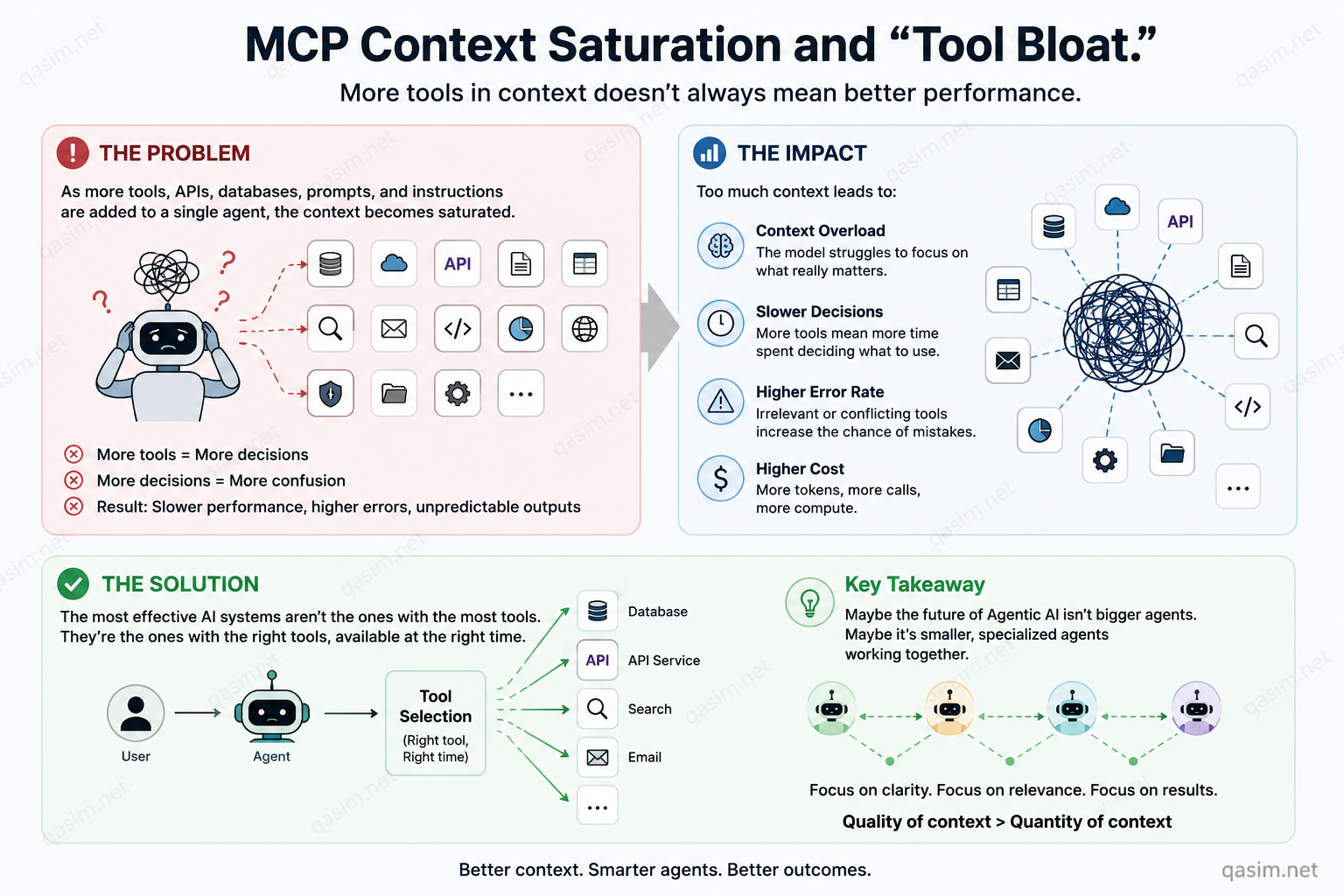
When More Tools Make AI Less Effective
As AI agents become more powerful, many developers assume that adding more tools will automatically make them smarter.
Unfortunately, the opposite is often true.
A common challenge in Agentic AI is something known as Context Saturation and Tool Bloat. As more APIs, databases, services, prompts, instructions, and integrations are connected to a single agent, the agent must process more information and make more decisions before taking action.
The result can be slower responses, higher costs, increased complexity, and less reliable outcomes.
Think of it this way: giving an AI agent access to every possible tool is like handing a mechanic every tool in a hardware store when all they need is a wrench. More choices do not always lead to better decisions.
The most effective AI systems are not the ones with the largest collection of tools. They are the ones that provide the right tools at the right time.
This is where MCP (Model Context Protocol) and modern agent architectures become important. Instead of building one massive agent responsible for everything, organizations can create smaller, specialized agents focused on specific tasks such as sales, customer support, reporting, procurement, or inventory management.
These specialized agents can collaborate when necessary while maintaining a clear and focused context.
The future of Agentic AI may not be bigger agents with more tools. It may be intelligent ecosystems of smaller agents working together through standardized protocols and well-defined responsibilities.
In AI, as in software architecture, simplicity often scales better than complexity.
Quality of context is more important than quantity of context.