How AI Is Transforming Every Phase of SDLC
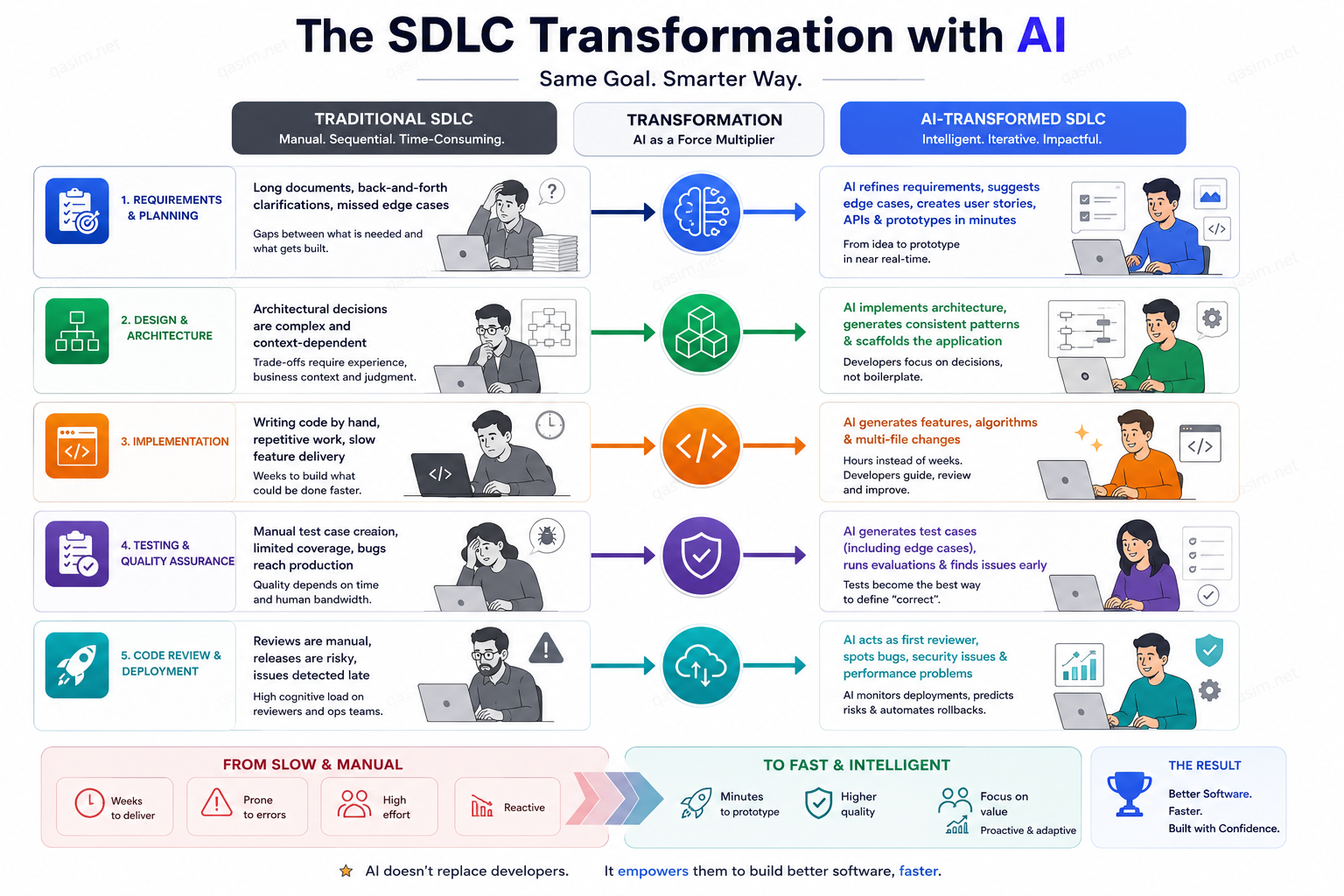
For decades, the Software Development Life Cycle (SDLC) followed a familiar path. Teams gathered requirements, designed the solution, wrote code, tested the application, deployed it, and maintained it over time. While Agile, DevOps, and Continuous Integration made this process faster, the fundamental phases remained the same.
Today, Artificial Intelligence is driving the next major transformation.
The SDLC isn’t being replaced—it is becoming more intelligent.
The Traditional SDLC
A typical software project followed this sequence:
Requirements → Design → Implementation → Testing → Deployment → Maintenance
Implementation was often the longest and most time-consuming phase. Developers spent days or weeks writing boilerplate code, integrating APIs, fixing syntax errors, debugging issues, and manually testing features before they could be deployed.
AI is changing where the bottlenecks exist.
Requirements Become Interactive
Traditionally, business requirements were written in documents and handed over to development teams.
This often resulted in misunderstandings between stakeholders and developers.
Modern AI tools can now:
- Generate user stories from business ideas
- Suggest missing edge cases
- Create API specifications
- Produce wireframes and prototypes
- Convert natural language into technical specifications
Instead of waiting weeks to validate an idea, teams can now create working prototypes in minutes.
The conversation shifts from “Write the specification first” to “Let’s build a prototype and refine it together.”
Architecture Becomes Even More Important
AI can generate thousands of lines of code.
It cannot decide whether your application should use microservices, a monolithic architecture, event-driven communication, or serverless infrastructure.
Those decisions still require human experience.
As implementation becomes easier, architectural thinking becomes more valuable.
Developers are spending less time writing boilerplate code and more time designing systems that AI can implement consistently.
Implementation Is No Longer the Bottleneck
This is perhaps the biggest change.
AI coding agents can:
- Build complete features
- Modify multiple files
- Generate APIs
- Refactor existing code
- Write documentation
- Create unit tests
Tasks that once required days can often be completed in hours—or even minutes.
Instead of typing every line of code, developers now guide, review, and improve AI-generated implementations.
Implementation is becoming an intelligent collaboration between humans and AI.
Testing Evolves from Detection to Validation
Testing is no longer just about finding bugs.
It is about verifying that AI built the correct solution.
Modern AI can:
- Generate unit tests
- Suggest edge cases
- Create regression tests
- Validate business rules
- Improve test coverage
Developers define what “correct” looks like, while AI helps verify that those expectations are met.
AI Joins the Code Review Process
Code reviews have traditionally relied entirely on human reviewers.
Now AI can perform the first review by identifying:
- Security vulnerabilities
- Performance issues
- Coding standard violations
- Potential bugs
- Duplicate code
Human reviewers can then focus on architecture, maintainability, business logic, and long-term design decisions.
Smarter Deployment and Maintenance
AI is also improving software after deployment.
Modern platforms can:
- Monitor application health
- Detect anomalies
- Predict failures
- Recommend rollbacks
- Analyze production logs
- Suggest performance improvements
Maintenance is becoming proactive rather than reactive.
Instead of waiting for users to report issues, AI can identify potential problems before they become critical.
The Biggest Shift Isn’t Coding
Many people believe AI is changing software development because it writes code.
That’s only part of the story.
The bigger transformation is that the focus of the SDLC is moving away from manual implementation and toward better thinking.
Developers are becoming:
- Better problem solvers
- System designers
- Architects
- Reviewers
- AI orchestrators
Code is becoming easier to generate.
Clear requirements, thoughtful architecture, and effective validation are becoming the new competitive advantage.
The Future of the SDLC
The phases of software development are not disappearing.
Requirements, design, implementation, testing, deployment, and maintenance will always exist.
What is changing is who performs the work and where the bottlenecks occur.
Implementation is accelerating through AI.
Architecture, judgment, verification, and business understanding remain uniquely human strengths.
The future SDLC is not simply faster.
It is more collaborative, more iterative, and more intelligent.
Organizations that combine human expertise with AI-assisted implementation will deliver software faster while maintaining the quality, reliability, and scalability that modern applications demand.
The future of software development isn’t about replacing developers.
It’s about empowering them to spend less time writing code and more time building the right solutions.