Greenfield vs Brownfield Projects

When planning a new business setup, factory, IT system, construction site, or infrastructure expansion, two common project types are usually discussed:
- Greenfield project
- Brownfield project
Both terms are widely used in construction, manufacturing, IT implementations, real estate, airports, and large-scale industrial projects.
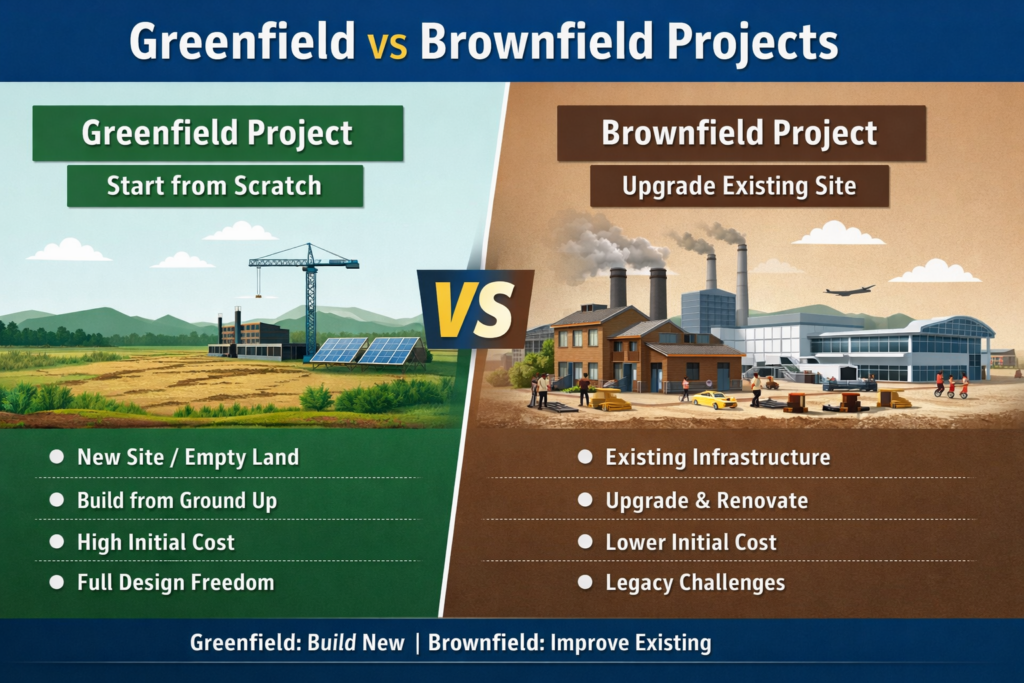
What is a Greenfield Project?
A greenfield project means starting from zero on a completely new site, with no existing buildings, systems, or infrastructure in place.
In simple words, it is a fresh start where everything is designed and built from scratch.
Common examples of greenfield projects
- Building a new factory on empty land
- Launching a new website or mobile app from the beginning
- Implementing a new ERP or CRM system for a business that never had one
- Developing a new township or residential project
- Constructing a new solar plant on unused land
Typical characteristics of greenfield projects
Greenfield projects offer the advantage of complete design freedom. Since nothing exists, teams can select modern technology, ideal layouts, and efficient processes without needing to adjust for older systems.
However, greenfield projects can take more time and often require higher investment because everything must be built from the ground up, including groundwork, approvals, utilities, and infrastructure.
What is a Brownfield Project?
A brownfield project means working with an existing site or system and upgrading, expanding, replacing, or improving it.
Instead of starting fresh, the goal is to improve what already exists.
Common examples of brownfield projects
- Upgrading an old factory with new machines and automation
- Modernizing an existing website or migrating it to a new platform
- Replacing an old ERP system while the business continues operating
- Expanding an existing airport terminal
- Renovating an old building and adding new facilities
Typical characteristics of brownfield projects
Brownfield projects are often faster and may cost less initially because basic infrastructure already exists. In many cases, permissions and initial setup work are also easier compared to building in a new location.
At the same time, brownfield projects come with limitations. Teams must work within the boundaries of what is already present. Hidden issues can appear—such as outdated wiring, unstable code, missing documentation, or legacy data problems. Another major challenge is carrying out the work without disrupting existing operations.
Greenfield vs Brownfield Projects (Comparison)
| Factor | Greenfield Project | Brownfield Project |
|---|---|---|
| Starting point | Empty site / no system | Existing site / running system |
| Flexibility | High (free to design) | Limited (must fit existing setup) |
| Risk | Medium | Higher (legacy and integration issues) |
| Cost | Higher initial cost | Lower initial cost |
| Timeline | Longer | Shorter |
| Biggest challenge | Planning, approvals, full setup | Integration, downtime, hidden problems |
| Best suited for | New ventures and expansion to new sites | Upgrades and expansion of existing setup |
Greenfield vs Brownfield in IT and Software Projects
These terms are also used heavily in software, especially in ERP, CRM, websites, and enterprise systems.
Greenfield software project
A greenfield software project means creating a completely new system.
Examples:
- Building a CRM platform from scratch
- Developing a new mobile app
- Launching a new SaaS product
- Creating a brand-new ERP implementation for a startup
The main benefit here is clean architecture. Developers can plan data structure, security, UI, automation, and integrations properly from day one.
Brownfield software project
A brownfield software project means improving, upgrading, or rebuilding an existing system.
Examples:
- Upgrading an existing WordPress website and connecting it to a Django backend
- Migrating an old PHP system to a modern framework
- Integrating AI automation into an existing ERP
- Replacing a legacy CRM without stopping business operations
The biggest challenge in brownfield software projects is that old systems usually come with real-life complications: missing documentation, inconsistent data, plugins that break during migration, and dependencies that are hard to replace.
How to Decide Which Project Type is Better
When a greenfield approach makes more sense
A greenfield approach is usually the better option when:
- the business is starting fresh
- there is no existing system to upgrade
- long-term scalability matters more than short-term speed
- you want the system designed cleanly with modern technology
When a brownfield approach makes more sense
A brownfield approach is usually better when:
- the existing system is already in use
- stopping operations is not possible
- budget is limited and the upgrade must be gradual
- the business needs improvements quickly
Real-Life Example
Imagine a training academy that wants to improve its digital setup.
Greenfield scenario
The academy is new and wants to build everything fresh:
- new website
- online admissions
- new student CRM
- payment gateway
- WhatsApp/email automation
Brownfield scenario
The academy already has:
- a WordPress site
- Excel student records
- manual follow-up system
Now they want to add:
- online admissions
- automated lead follow-ups
- AI chatbot
- CRM integration
This would be a brownfield project because the new solution must work with the existing setup without breaking current operations.
A greenfield project is a fresh start where nothing exists and everything is created from scratch.
A brownfield project is an upgrade where you improve or expand what already exists.
Both are common and both are useful. The best choice depends on budget, timeline, and whether a working system already exists.